AC Clicking But Not Turning On in Katy, TX | Causes | Katy 24 Hour AC Repair
Hear a click, but your AC won’t start in Katy, TX? Here’s what’s causing it and whether it’s safe to keep trying. Call (346) 480-4090.
AC Clicking But Not Turning On in Katy, TX
A clicking sound with no system startup almost always points to an electrical component trying and failing to engage, most commonly the capacitor, the contactor, or a control relay. The click itself is usually the contactor attempting to close and complete the circuit; if the compressor or fan doesn’t follow with a hum and start, something downstream of that click isn’t getting the power or capacitance it needs.
What’s Usually Causing the Click
- A weak or failed run capacitor on the compressor and fan motors needs a capacitor-supplied surge to start; a capacitor testing well below its rated microfarad value can’t deliver it
- A failing contactor is the electromechanical switch that connects power to the outdoor unit; contacts can pit and wear from repeated cycling, causing intermittent or failed connection
- Tripped internal overload or a compressor that’s too hot to restart (common right after a brief power blip or a rapid on-off cycle)
- Loose or corroded wiring connection at the outdoor disconnect or contactor terminals
- A failing start relay on older single-stage systems, distinct from the capacitor itself
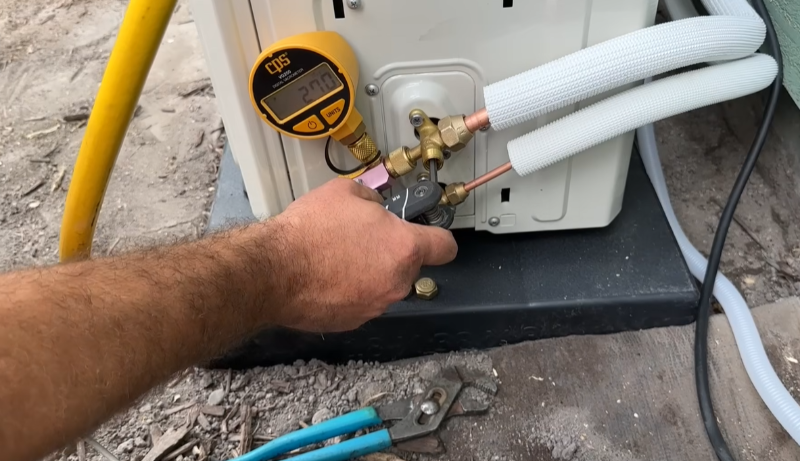
Testing a Capacitor — What ‘Weak’ Actually Means
A capacitor is rated in microfarads; for example, a run capacitor might be rated at 45 microfarads. When tested, a capacitor reading meaningfully below its rated value, say, in the low teens on a 45-rated capacitor, has lost most of its ability to deliver the starting surge a compressor or fan motor needs. This is one of the fastest, most common repairs we make, and it’s also one of the most misleading symptoms to guess at without testing, because a weak capacitor and a failed compressor can sound similar from outside the unit.
Is It Safe to Keep Trying to Restart It?
Repeatedly cycling the thermostat off and on to try to force a start isn’t dangerous by itself, but it won’t fix a genuine component failure and can add unnecessary wear if a compressor is trying to start against a weak capacitor repeatedly. If the outdoor unit clicks but never actually starts after two or three attempts spaced a few minutes apart, stop trying and call; further attempts risk turning a capacitor-only repair into a compressor issue.
Why This Fails More Often in Katy Summers
Sustained heat above roughly 95°F shortens capacitor lifespan meaningfully faster than in moderate climates, and Katy’s frequent summer thunderstorms add power fluctuations that stress these components further. This is why capacitor and contactor failures cluster heavily in July and August calls across every Katy neighborhood, regardless of home age.
Repair Cost for This Issue
Capacitor replacement is typically $150 to $350 and is usually completed within the same visit since it’s one of the most commonly stocked parts on our trucks. A contactor replacement runs similarly, generally $150 to $300. A start relay replacement on older systems is usually toward the lower end of that range. These are among the fastest and most affordable AC repairs, which is part of why testing before assuming a bigger problem matters; this symptom often has an inexpensive explanation.
Capacitor vs. Contactor — What’s the Actual Difference?
Both are electrical components involved in starting the outdoor unit, but they do different jobs. The capacitor stores and releases an electrical charge to help the compressor and fan motors overcome the resistance of starting from a stopped position. Think of it as a starting push. The contactor is a switch that physically connects and disconnects power to the outdoor unit based on the thermostat’s signal. Think of it as the gatekeeper deciding whether power flows at all. A failing capacitor typically causes a hum with no start; a failing contactor more often causes no response at all, or an intermittent one, since the switch itself isn’t reliably closing.
Frequently Asked Questions
Preventing Capacitor Failure
Capacitors are considered wear items rather than defects. When they fail, they’re expected to degrade over years of heat cycling, and a capacitor testing weak at a spring tune-up before it fails outright is one of the more useful catches a maintenance visit provides. Replacing a capacitor testing at 70% of its rated value during a scheduled visit avoids the same replacement happening as an emergency call weeks later during peak heat.
What Happens If the Issue Isn’t the Capacitor
If capacitor and contactor testing both come back normal, we move to checking the low-voltage control wiring and, if needed, the compressor itself for a locked-rotor condition. This is a smaller share of clicking-related calls, but ruling components out methodically, rather than replacing parts on a guess-and-check basis, is what keeps repair costs matched to the actual cause.