AC Tripping Breaker in Katy, TX | Causes & Safety | Katy 24 Hour AC Repair
AC unit tripping the breaker every time it starts in Katy, TX? Here’s what causes it and why you shouldn’t keep resetting it. Call (346) 480-4090.
AC Tripping the Breaker in Katy, TX
A breaker that trips specifically when the AC tries to start is the system drawing more current than the circuit is rated for, which happens for a specific, testable set of reasons. This is a symptom worth taking seriously rather than simply resetting a breaker repeatedly. Tripping is the electrical system doing exactly what it’s designed to do to prevent damage or fire risk, and it deserves a real diagnosis rather than being treated as an inconvenience to work around.
What Actually Causes a Breaker Trip on AC Startup
- A failing capacitor forces the compressor motor to draw excess current while struggling to start
- A locked or seized compressor drawing a large current spike on startup attempts
- A ground fault in the condenser fan motor winding, the motor’s insulation has broken down enough that current is leaking to the motor housing rather than staying in the circuit
- A wiring short somewhere between the disconnect and the unit, often from age, rodent damage, or corrosion
- A breaker itself that has weakened with age and now trips below its rated capacity is less common, but worth ruling out if the outdoor unit tests electrically normal
Don’t Assume — Test It. A Real Example.
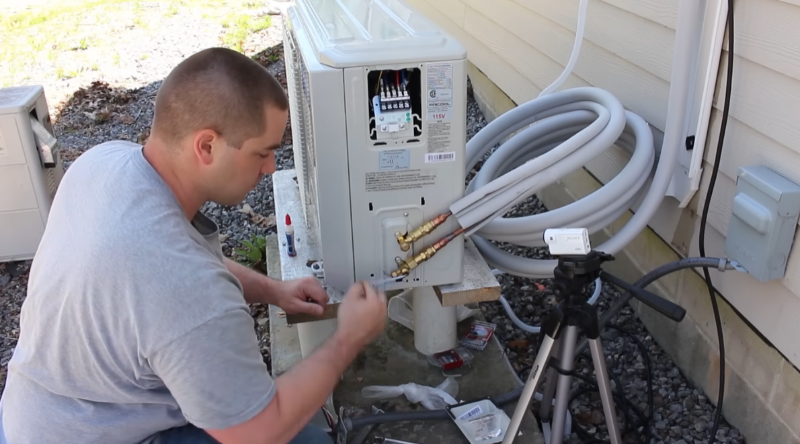
It’s a common and reasonable assumption that a tripping breaker means a failed compressor, since the compressor is the largest electrical load in the system. But testing amp draw directly on the compressor, rather than assuming from the symptom alone, regularly reveals a different cause. We’ve traced breaker trips assumed to be compressor failures back to a shorted condenser fan motor with a ground fault in its winding, a repair that costs a fraction of a compressor replacement. Testing the actual current draw before quoting any repair is the only way to avoid replacing a working, expensive component based on a guess.
Why You Shouldn’t Just Keep Resetting the Breaker
Each reset-and-retry cycle on a system with a genuine electrical fault adds more stress to already-failing components and, in the case of a wiring short or ground fault, carries real fire risk. If the breaker trips more than once on the same startup attempt, stop resetting it and call for a diagnostic rather than continuing to cycle it. This is one of the few AC symptoms where waiting or repeated DIY attempts can escalate a moderate problem into a dangerous one.
Storm-Related Electrical Stress in Katy
Katy’s frequent summer thunderstorms bring brief power fluctuations and occasional near-strikes that stress AC electrical components even when a full outage doesn’t occur. Homes that have gone through a storm season without issue can still develop a marginal capacitor or a weakened motor winding that only fully fails weeks later under sustained heat load, which is part of why breaker-trip calls cluster in the weeks following active storm periods as much as they do on the single hottest days.
Repair Cost for This Issue
A capacitor-caused trip is the least expensive outcome to resolve, typically $150 to $350. A shorted fan motor generally runs $300 to $700, including labor. A compressor issue is the most expensive path, from roughly $1,200 up to full replacement territory. Given this range, testing amp draw before quoting is the difference between a homeowner paying for a fan motor and a homeowner being sold an unnecessary compressor replacement.
When the Issue Is Actually the Breaker or Wiring, Not the AC
Occasionally, the AC unit itself tests electrically normal and the problem traces back to the breaker itself weakening with age, or to wiring between the panel and the disconnect. This crosses into licensed electrician territory rather than HVAC repair specifically, and it’s worth knowing that distinction going in a fully normal-testing AC unit with a persistent breaker trip is a legitimate reason to involve a licensed electrician alongside the HVAC diagnosis rather than assuming the AC company can resolve a panel-level issue.
Frequently Asked Questions
What Happens When You Call Us for This
Because this symptom has a wide range of possible causes and a real safety dimension, we prioritize breaker-trip calls similarly to no-cooling emergencies rather than treating them as routine. On arrival, we test the disconnect, the contactor, the capacitor, and amp draw on both the compressor and fan motor before touching the breaker itself, so the diagnosis is based on the AC system’s actual electrical behavior rather than assumption.
What We Check, In Order
We start with a visual inspection of the disconnect box and wiring for obvious damage, then test the capacitor, then the contactor, then amp draw on the fan motor and compressor individually. Testing components in this sequence, from simplest and least expensive to most complex, means we catch an inexpensive cause before ever recommending an expensive one and it means the diagnosis is documented step by step rather than delivered as a single unexplained verdict.